Monday, 15 June 2015

Rosemary Beetle - new to the garden

14th June 2015 - Topsham


As a change from counting Med Gulls and straining eyes to read colour rings on Blacke-headed Gulls and Sandwich Terns, I've been out and about with my macro lens. Here's a new beetle for the garden list - Chrysolina americana, commonly known as the Rosemary Beetle.

Chrysolina americana, on Bindweed Calystegia sp. - 12/6/2015 Topsham

Chrysolina americana, on Lavender Lavandula angustifolia - 14/6/2015 Topsham

I know neither of these are on Rosemary but they are right next to a Rosemary bush, these were just easier to photograph. With the name americana you might think this is a transatlantic import, in fact it comes from south and east Europe; the americana bit was attached by Linnaeus in 1758 and I can only guess he was mistaken as to the specimen's origin. It's pretty unmistakeable, up to 8mm long, a typical leaf beetle (Chrysomelidae) and very shiny with blue and purple/gold stripes; C.cerealis, the only similar native species, occurs only in Snowdonia.

The species was first found in Surrey in 1994, it's now all over south east England with a few records from the south west, it's also spread to Wales, Scotland and Ireland. It feeds on, not surprisingly, Rosemary and Lavender, but also related plants such as Sage and Thyme of the family Lamiaceae. The RHS class it as a pest so there's an argument for destroying it. On the other hand, if you're going to import and grow non-native plants you have to expect to deal with their associated fauna. There doesn't appear to be any evidence it will seriously affect native species. It's a beautiful thing and I think I'll just leave them be.

Friday, 12 June 2015

I've been away...

...for a week or so. Lucky for me nothing spectacular turned up locally and, more to the point, nobody found that mega gull at Topsham Rec that I've been waiting for.

First a few photos of Great White Egrets and Bittern from Ham Wall, Somerset. A drive to Bath to collect offspring number two and her belongings from Bath Uni gave me the excuse for a morning's birding at the Avalon Marshes. This place gets better with each visit, Marsh Harrier, Hobby, four spp. of Heron (and I didn't see Little Bittern or Night Heron), even an amphibian tick in Marsh Frog - (noisy and everywhere right now). Photos weren't that great, bright sun mostly and I always seemed to be in the right place at the wrong time.


Great White Egret - 10/6/2015 Ham Wall, Somerset. Dark bill and reddish tibia of a breeding bird.

Great White Egret - 10/6/2015 Ham Wall, Somerset. Dark bill, reddish tibia and long back plumes/aigrettes of a breeding bird.

Bittern - 10/6/2015 Ham Wall, Somerset

Bittern - 10/6/2015 Ham Wall, Somerset

So that's one day accounted for, what about the previous week? Well, just a short cycle ride across the country. Known as the Way of the Roses or, as it turned out, a tour of the best pie shops between Morecambe Bay and Flamborough Head. Interesting to return to the old home county - some great scenery and fine food - but it definitely confirmed my original good sense in moving south all those years ago.

Little birding possible given all those miles to cover (190 with the requisite detours and faffing) but interesting to see/hear so many breeding Curlews in the Dales and numerous Corn Buntings in East Yorkshire. And Red Kites of course.

Red Kite - 6/6/2015 Haxby, Yorkshire

Red Kite - 6/6/2015 Haxby, Yorkshire

Not forgetting the holiday snaps:

The Start, already looking forward to second breakfast.

somewhere up north

even further north

Sunday, 24 May 2015

American Golden Plover, Gull-billed Tern and stacks of Red Kites

23rd May 2015 - Topsham and Exminster Marshes


I was thinking about breakfast and wondering whether to go to Bowling Green Marsh or maybe popping across the river. I'd decided to consider it over breakfast when Dave Stone called - James Diamond had found an American Golden Plover on Exminster Marshes. Twenty minutes later, coffee in thermos but still lacking breakfast, I was watching said bird at a range of something like 500m from the canal bank. Mostly it was just a head and neck appearing above the grass or out of a ditch, although it sometimes came into full view allowing a look at the all-important back end - long primary projection beyond tail and short tertials. Photos were clearly out of the question. It was a dull greyish bird with only blotches of black below ghosting the full breeding plumage pattern, a prominent dark cap and a broad white supercilium curving down the neck and breast sides. Despite watching on and off for about two hours I never saw it fly and the only time it spread its wings it was facing away.

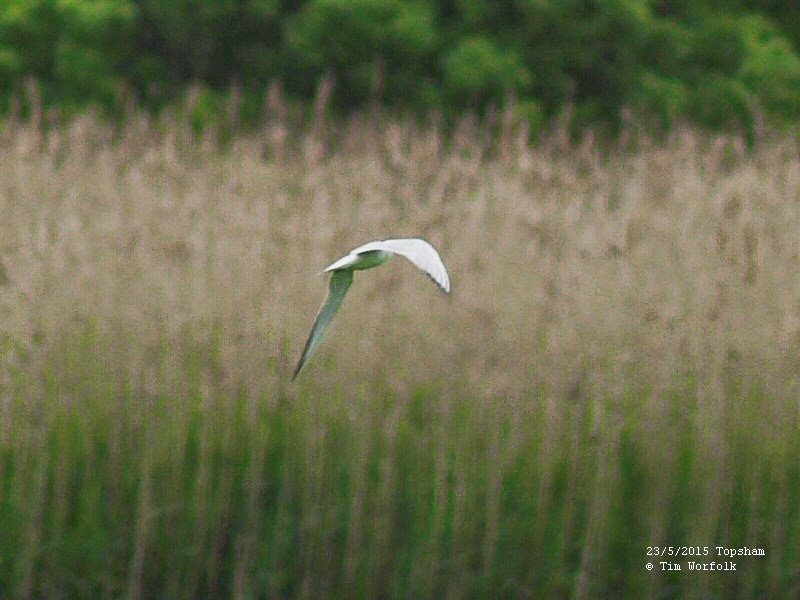
While waiting for better views (and still thinking of breakfast), Keith Birchall called. Having decided to forgo the American GP, he was at BGM for the morning high tide and just happened to bump into a cracking Gull-billed Tern (now seriously regretting my earlier indecision, if I'd stayed for breakfast and gone to BGM?). Another twenty minutes in the car, and luckily opting at the last minute to drive straight there rather than stopping to pick up my bike, and I got to the hide just minutes before the tern flew out.

Some distant shots as it departed.

Gull-billed Tern - 23/5/2015 Topsham

Gull-billed Tern - 23/5/2015 Topsham

Gull-billed Tern - 23/5/2015 Topsham

All that and before breakfast. Mind you, it did remind why I hate twitching, even locally.

And the Kites? Most recent years I expect to see maybe one over the house. As I headed out the back door with the dog on our daily visit to the Rec a Red Kite appeared over the cemetery. I grabbed my camera from my rucksack and called to Carolyn in the kitchen, another followed, then another. At least five, possibly six as I lost birds at times behing trees and houses, gaing height and drifting north west.

Red Kite - 23/5/2015 Topsham

Red Kite - 23/5/2015 Topsham

Red Kite - 23/5/2015 Topsham

Red Kite - 23/5/2015 Topsham

I'd always assumed that our annual summer influx involved 2nd year birds, on a 'teenage wander' before reaching breeding age. From these photos it's possible to make out the pale undertail coverts shown by juveniles and most 2nd years. All were in moult but this doesn't help as all ages should be in primary moult at this time of year.

I soon got another call from Keith, who was now on the Exminster side, and who'd had twenty plus travelling west across the estuary, I picked up another five high and distant against the Haldon Hills. Ten in a day and a year total of 14 so far.

Monday, 18 May 2015

Avalon Marshes

16th May 2015 - Shapwick and Ham Wall


I first visited this area of the Somerset Levels back in June 1989 when I saw my first and only UK Roller. It's all a bit different now, several square miles of shallow pools, reedbeds and wet woodland hosting an impressive range of special breeding birds. In recent years I usually make at least one trip in spring and I'm always amazed at how good it is. No Bitterns this time, a bit late in the day perhaps, but plenty of Hobbys in the air feeding on dragonflies, the Great Whites were in full breeding condition - dark bills and red legs, and at least a couple of Marsh Harriers were on display.

Marsh Harrier male - 16/5/2015 Shapwick, Somerset

Marsh Harrier male - 16/5/2015 Shapwick, Somerset

Marsh Harrier male - 16/5/2015 Shapwick, Somerset

Hobby 16/5/2015 - Shapwick, Somerset (hard to count but probably at least 20 over the marshes scoffing the dragonflies and completely ignoring the swifts and hirundines - not on the menu today)

Great White Egret 16/5/2015 - Shapwick, Somerset (distant but shows the dark bill and red legs of a bird in peak breeding condition)

Great Crested Grebe 16/5/2015 - Ham Wall, Somerset (my camera does occasionally take half decent photos - if the bird's near enough!)  

And no, I didn't go up for the Hudsonian Godwit. I pretty much hate big twitches these days and anyway, I've every confidence it'll turn up somewhere nearby this autumn - the upper Exe Estuary is a 'traditional' site after all!

Saturday, 2 May 2015

Common and Spotted

1st May 2015 - Topsham


In all the years I've been birding Topsham Rec these are the best photos I've taken of Common Sandpiper, they're normally just too far away, too wary and too hard to sneak up on. These shots may not be that great but they do, at least, show the subtle seasonal variation in appearance of Common Sands, i.e. the dark barring on the scapulars and coverts and the faintly spotted breast of breeding plumage.

Common Sandpiper - 1/5/2015 Topsham

Common Sandpiper - 1/5/2015 Topsham

Common Sandpiper - 1/5/2015 Topsham
 Compare with these shots of the long-staying Spotted Sandpiper which I found at the Rec back in 2009. This bird was tame, eventually.

Spotted Sandpiper - 23/12/2009 Topsham

Spotted Sandpiper - 5/1/2010 Topsham

Spotted Sandpiper - 5/1/2010 Topsham

Spotted Sandpiper - 5/1/2010 Topsham

Spotted Sandpiper - 5/1/2010 Topsham
It was typically quite unapproachable at first - I first suspected it on 20th November but it took a few days to get good enough views and photos to confirm it. By a month later it was extremely confiding, or rather was so desperate for food in the severe weather it would feed along the footpath - even creeping under gates into gardens. I was using a 180mm macro lens at the time and even then the bird would come so close I could barely keep it all in frame. The 5th January was the last day I saw it, overnight the temperature dropped to -10 and the river partly froze. I heard reports that it was still present but I'm sceptical - I was at the Rec most days and while there were a few Common Sandpipers, there was no Spotted.

Monday, 27 April 2015

2nd year Yellow-legged Gull

26th April 2015 - Topsham


As you may have noticed, I like to pop down to Topsham Recreation Ground on an afternoon to look at the gulls. Sometimes I take my scope, sometimes I take my dog, rarely both at the time. Today I took the dog. This inevitably put a slightly different perspective on my gull watching, harder to see details but general impressions are more obvious perhaps. It turned out to be my most interesting/rewarding session in months (this is clearly not saying much - it's been dire). I found my first genuine Yellow-legged Gull of the year.

This is not a plumage I'm particularly familiar with, most michahellis I see are fresh 1st year birds in late summer. Although this bird's wings are still essentially 1st year, ongoing body and scapular moult has changed its appearance considerably from what it would have looked like last August. It took me a few minutes to see enough of the wings and particularly the tail to convince myself. The grey mantle feathers might suggest a 2nd winter/3rd cal yr bird in argenteus but michahellis is more advanced in these things. The wings don't lie, however, and are clearly mostly 1st generation feathers - though still fairly unbleached and unworn suggesting this bird hasn't wintered too far south.

Yellow-legged Gull 2nd cal yr - 26/4/2015 Topsham
 The classic 1st year mick tail pattern looks like nothing shown by a Herring Gull. The first thing I noticed.

Yellow-legged Gull 2nd cal yr - 26/4/2015 Topsham
 Dark underwing coverts, and the breast sides and flanks are fairly neatly marked with spots or chevrons on white background, typically dirtier, more smudged and blotchy in Herring Gull.

Yellow-legged Gull 2nd cal yr - 26/4/2015 Topsham
 The wing is still mostly juvenile with a few inner coverts at least replaced. The coverts are basically dark-centred with little obvious barring typical of michahellis. Primary moult has already started with P1 and 2 dropped, a little more advanced than argenteus.

Yellow-legged Gull 2nd cal yr - 26/4/2015 Topsham

Yellow-legged Gull 2nd cal yr - 26/4/2015 Topsham

Yellow-legged Gull 2nd cal yr - 26/4/2015 Topsham 

Less obvious when sat or standing perhaps but still looking subtly different from the other 2nd years. The combination of dark 1st generation (mostly) wings with the rather 2nd winter like mantle is slightly incongruous. Those plainer greyish scapulars are presumably 3rd generation feathers.

A note on age terminology: this bird hatched and fledged last summer and is approaching its 1st birthday, so it's in its 2nd calendar year (2nd year would be appropriate). As we're in late April it could be called either 1st winter or 2nd summer (1st spring never seems to get used). In terms of moult, it's started primary moult so is now a 2nd cycle bird - those 2nd generation P1 & 2 are there, they just haven't grown long enough to be seen yet.

Many thanks to Martin Elliott for the helpful discussion.

Tuesday, 14 April 2015

Same as it ever was

14th April 2015 - Topsham


Topsham Rec continues to throw up these little delights; so far this year my local gull highlights have been an occasional Med Gull and a couple of these.

Presumed hybrid gull - 14/4/2015 - Topsham

Presumed hybrid gull - 14/4/2015 - Topsham

Presumed hybrid gull - 14/4/2015 - Topsham

Presumed hybrid gull - 14/4/2015 - Topsham

I never really expected it to be a genuine michahellis, getting a little cynical in my dotage perhaps, but it looked a little small and dainty alongside a Herring Gull. It was obviously darker mantled and its leg colour appeared to have a definite yellow component but, as usual, the primary pattern gave the game away. Too much black on P10 and P9 (reaching primary coverts), and too little on P5 (only a broken band); just right for Lesser Black-backed though. After a closer look, the legs weren't that yellow, just yellowish. Could it have been passed off as a Yellow-legged?

This isn't my first of the year, I've seen this individual, with its oddly pale outer primaries, a few times over the last month.

Presumed hybrid gull - 27/3/2015 - Topsham
 The legs looked yellower in the field than in the photos.

Presumed hybrid gull - 2/4/2015 - Topsham
 P8 pale, not solidly black, on both wings. An adult last year - same bird? - showed a similar mark on one wing only.

Presumed hybrid gull - 2/4/2015 - Topsham

Legs look more pink now.

Presumed hybrid gull - 2/4/2015 - Topsham

You gotta take your pleasures where you can.