Monday, 30 September 2013

Greenshanks

28th September 2013 - Topsham


Some drawings for a change. After spending the last few weeks on detailed illustration work - the Black-capped Petrel and Cahow plate for the Tubenose Handbook - it's nice to be able to just please myself and draw and paint as loose and rough as I like. From the viewing platform by the Clyst I found a small group of winter-plumaged Greenshanks resting by the water's edge on the rising tide. One or two were scratching and preening, some wandered about feeding, most were just resting.


And a few mug shots with a touch of watercolour.


Thursday, 26 September 2013

Why can't all waders be this tame?

25th September 2013 - Topsham


I use a modest 300mm f4 lens, usually with a 1.4x teleconverter, so in order to get anything more than 'record shots' I need to be fairly close to the bird. Like paparazzi-shy celebrities the birds usually don't want to co-operate; I've had a flock of gulls - the same birds that would cheerfully steal an ice cream from your hand - take off when they notice my lens pointing at them. But of all the waders using the Exe, from Dunlin to Curlew, it's consistently the juvenile Black-tailed Godwits that are the most confiding. Any Common Sandpiper, Redshank or Greenshank on my side of the river will fly it if even thinks I'm going to head its way. The Godwits just look up, then carry on feeding, often walking towards me. I've probably got more decent photos of Blackwits than any other wader; here's a few from the Recreation Ground, all cropped but halved in size.

Black-tailed Godwit juvenile - Topsham 25/9/2013
The first two photos (above and below) show a bird which is still mostly in juvenile plumage, just one of the longer scapulars has been replaced by a plain grey adult type feather.

Black-tailed Godwit juvenile - Topsham 25/9/2013
Here's another bird (below) still wearing almost a full set of juvenile feathers, it's hard to judge but there might be a few new scapulars appearing.

Black-tailed Godwit juvenile - Topsham 25/9/2013
This one (next two photos) is more advanced in its moult, showing a lot of new plain adult type scapulars and patches of new grey feathers on the breast sides and flanks.

Black-tailed Godwit juvenile moulting to 1st winter - Topsham 25/9/2013
To be honest, it's not just Godwits; I did manage to approach a Spotted Redshank quite closely earlier in the day. It would have been sharper - the light wasn't that low - but the early mist on the river killed all contrast, a bit like shooting through a dirty window.

Spotted Redshank juvenile - Topsham 25/9/2013


Saturday, 21 September 2013

Nothing rare at all...but still good value

20th September 2013 - Topsham Recreation Ground


My excuse is usually that 'the dog needs a walk', or I tell myself that 'someone's got to check the gulls' or that 'I need the exercise and fresh air'. Whichever, it's a privilege and a pleasure to be able to just 'pop down the Rec' to see what's about and to never know what I'm going to see. I usually have the place to myself, which means that anything 'good' is usually mine to find - I suppose it also means that a lot gets missed, but that's how I like it. My nightmare scenario must be to get to my usual gull scanning spot and find someone already there gloating over a Laughing Gull or even 'just' a Caspian Gull (with one record each both equally rare at the site).

So it's only natural, as I head down the road, to sometimes fantasise about what I'm going to find. It's usually nothing unusual but the occasional surprise keeps me going back. Here's today's surprise.


Grey Seal is not particularly unusual maybe, but it's only my third sighting this high up the Exe. I guess it had followed the Mullet up river and was now heading back to sea before getting stranded on the falling tide. I wondered what the dog would make of sharing the river with that but, perhaps fortunately, she wasn't swimming that day.

I checked the large gulls loafing on the spit, where, as usual there was nothing unusual. I had a quick look up the river in case the Lesser Yellowlegs was showing, it wasn't. There were no waders in the vicinity so I turned to my fall-back option and photographed a Cormorant fishing nearby.


After polishing off a small flatfish - Plaice or Flounder? - it came up with a young Eel.


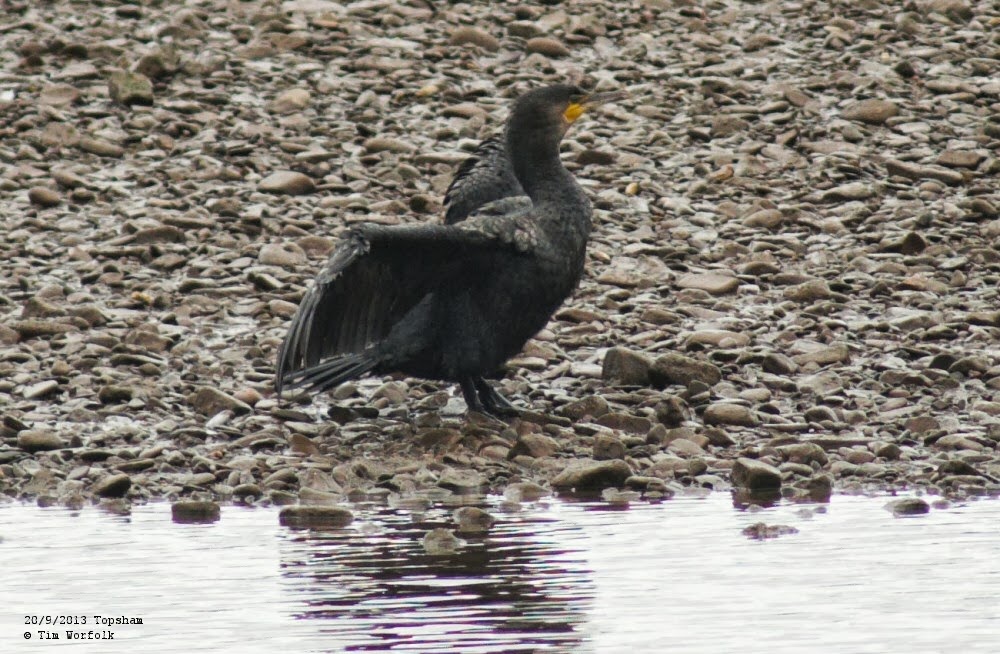
Then, full or just needing to warm up, it swam to shore and rested with wings spread to dry.


Two more Cormorants were nearby, another 2nd year bird and, behind it, a browner backed, white-bellied juvenile.


Of course there's more to be done with these birds. The two 2nd years are both sinensis while the juvenile appears to be nominate carbo. Here's a closer look at the first bird showing the almost 90° angle formed by the gape line and the rear edge of the yellow gular skin. On the carbo the angle is much smaller. These two 'Continental Cormorants' have been hanging around this stretch of the Exe for the last week or so yet, oddly enough, have not provoked the slightest interest - if I mention them to visiting birders I just get blank looks, is it me?


And as if there weren't enough good reasons to pay more attention to Cormorants, just think, one day you might find one of these...


Saturday, 14 September 2013

Lesser Yellowlegs

13 September 2013 - Trews Weir/Exeter Quay


I couldn't resist this, a Lesser Yellowlegs just a few miles away and, more to the point,  confiding and very photograph-able. There'll be many better photos of this bird but here are a few of mine.


Thursday, 12 September 2013

Suspect gulls, odd godwits and Cormorants under the radar.

Pressures of work, concern for my carbon footprint and a determination not to miss anything good on my own patch have predictably resulted in me seeing little of note in the last month. Still, two weeks have gone since my last post so I thought I'd drop these in before my absence is noted.

2nd September 2013 - Exeter Quay


I've still only seen one definite Yellow-legged Gull so far this Autumn. Nothing has shown up yet at Topsham so I tried again at Exeter Quay. Along with a couple of other suspects - intriguing but ultimately unsatisfying - I found this individual.


Here's what I got of it in flight - not a crop, it was really close.


Inexpert as I am, I was initially of the view that this was a michahellis but after Martin Elliott put me right on a few things our (well, actually his) conclusion was that it's most likely to be a graellsii Lesser Black-backed. In favour of Yellow-legged, the best character here is the tail, a fairly narrow, neat black band with a lot of white in the outer retrices. It's moulted a few scapulars and has replaced a couple of greater coverts and tertials on the left wing and a central tail feather (somewhat unusual for a Lesser Black-backed so maybe due to damage?). The main reason why it's probably not a michahellis is the freshness of the plumage - typically by now the coverts should be a lot more worn and there should be many more 2nd generation scapulars. So on balance of probability it's most likely an atypical graellsii; still I can't help complicating things by mentioning the western Iberian lusitanius Yellow-legged Gull, which is typically a month behind michahellis in moult and presumably extremely hard to tell from graellsii?

7th September 2013 - Topsham Recreation Ground


I don't get many close photo-ops with waders at the Rec so I grabbed a few of these obliging Black-tailed Godwits.
The first is a fairly standard first year bird showing typical juvenile coverts and scapulars with a few new adult winter type feathers on the mantle and possibly, though it's hard to tell, inner wing coverts.


The next one is a striking bird which still puzzles me. The head and body look fine for a juvenile if possibly a little well barred on the breast and flanks. The mantle and coverts show no plain adult winter type feathers, they're all apparently the same generation, again right for a juvenile. But the feather pattern looks very odd for a juvenile, the coverts, tertials and scapulars should look more or less dark with some faint barring and neat gingery fringes - pretty much as in the first bird. The strong barring - particularly along the length of the tertials - looks much more like that of a breeding adult.


Edit 14/9/2013 - I should have checked a little more thoroughly - or pay more attention to common birds; the boldly barred juvenile Black-tailed Godwit is apparently not unusual in the race islandica which, of course, is the usual subspecies on the Exe.

10th September 2013 - Topsham Recreation Ground


No identification issues here, in spite of the atrocious photo. I was surprised to see a good sized flock of Dunlin, not common this high up the river. I knew there were a few Curlew Sandpipers in the area and, sure enough, here are two of them with their white rumps gleaming as the flock took off. No prizes for picking them out but if you can spot a Little Stint - a patch tick - in there I'd be delighted, I couldn't.


11th September 2013 - Topsham Recreation Ground


Finally a nice pair of Cormorants, both apparently second year birds, and both showing the only 'safe' identification character of the form sinensis.


This is one of the few opportunities for birding with a protractor, as all birders with a nerdy tendency know. The only way to be certain of sinensis is to measure the gular angle (the gular area/pouch is that yellow skin at the base of the bill, the gular angle is the angle formed by the gape line and the rear edge of the gular skin - try to keep awake, there may be a test at the end).
So of course, I cropped and enlarged the photos and measured the angles. The top bird is pretty much exactly perpendicular, the lower not quite but close so I'm pretty confident of these angles. According to Newson et al (2004) the overlap in angles between nominate carbo and sinensis is 66-72°, these both exceed that by some way so must be sinensis.


The last Devon Bird Report (2011) contains only a single record of this form. I find them to be fairly frequent on the Exe so I guess nobody else is looking.

Reference

Newson S.E., B. Hughes, I.C. Russell, G.R. Ekins & R.M. Sellers 2004. Subspecific differentiation and distribution of Great Cormorants Phalacrocorax
carbo in Europe.
Ardea 92(1): 3-10.


Monday, 26 August 2013

Bulwer's Petrel - the same the World over?

I don't do much seawatching anymore, a few good boat trips spoiled it for me. A couple of years ago I spent a few days on, or rather a few miles off, Madeira getting to grips with some of the Western Palearctic's rarer and more local species. As I had hoped, Bulwer's Petrel Bulweria bulwerii were numerous and often close. They weren't too easy to photograph, they moved fast and the boat rolled on the swell, but at least they kept coming past and, by blasting off hundreds of shots, I got a few half decent images.


Tubenoses which breed in low to mid latitudes tend to be quite restricted in their breeding sites, Bulwer's isn't. Of the 'big five' Madeira tubenose specialities, two species, Zino's Petrel Pterodroma madeira and Desertas Petrel P.(feae) deserta, are extremely rare and breed only on one island each; while three, Bulwer's Petrel, White-faced Storm-petrel Pelagodroma marina and Madeiran (or Band-rumped) Storm-petrel Oceanodroma¹ castro, are both fairly numerous and are found in both the Atlantic and the Pacific.

Of course I know things are a little more complicated than that; Madeiran Storm-petrel in the strict sense only breeds in the Madeiran and Canarian archipelagos, the other taxa in the complex being variously regarded as subspecies or species.  White-faced Storm-petrel (with up to six subspecies) breeds on islands in the North and South Atlantic and also from southern Australia to the western Pacific.

Bulwer's Petrel is found breeding in tropical and sub-tropical zones across The World's oceans from the eastern Atlantic to the central and western Pacific and the western Indian Ocean (it may also breed in the South Atlantic on St. Helena). However, unlike the two Storm-petrels, there are no recognised subspecies. Bulwer's Petrels from Hawaii and the seas off Taiwan appear to be identical from those from Madeira and the Canaries - there appear to be no plumage or size differences that I can detect from specimens. Other than Jouanin's Petrel Bulweria fallax, which, when lumping was the fashion, was sometimes thought to be conspecific with Bulwer's (in fact it's much bigger and a different shape), I don't think Bulwer's has ever had any subspecies. The monotypic multi-ocean distribution of Bulwer's Petrel is, in fact, so unusual for a (sub)tropical tubenose that only Wedge-tailed Shearwater Puffinus² pacificus shows a similar pattern, although in this case it does not occur in the Atlantic.

I'm not aware of any research into the genetics of these populations though I suspect the results would be interesting.

Many thanks to Caterina Fagundes and Hugo Romano of Madeira Windbirds for some quite splendid boat trips, I can't recommend them too highly.

 ¹ It has been suggested that this species (species group) differs so much from 'typical' Oceanodroma that it may be better placed in it's own genus Thalobata.

 ² Like the other large shearwaters, probably better placed in a separate genus Ardenna.

Friday, 16 August 2013

Getting distracted again

13th-15th August - Topsham


The days are long and so are the gaps between posts. I could make excuses about pressures of work but the truth is I've been taking a bit of a break. There doesn't seem to be much happening bird-wise locally (maybe I'm not looking hard enough) so I find my attention wandering. As a five minute break from my desk, I like to take a walk down the garden with my macro lens/tripod set-up. There's nearly always something of interest. So, at the risk of disappointing those expecting photos of gulls, sketches of birds or even an update on my Tubenose work, here are some more insect photos. All taken in my back garden in the last few days - the technical details (if anyone's interested) are: Nikon D200, Sigma 180mm macro, Uniloc tripod and Manfrotto ball head, no flash, just long exposure, mirror lock-up, cable release and wait for the wind to drop.

First here's a bug, Deraeocoris ruber, family Miridae. I've photographed this species a few times and it varies a lot in colour; this is a paler individual, some are quite blackish - mostly males according to Southwood & Leston (1959). Both adults and young are predators of aphids and other small insects.


The next two shots show a Hoverfly, a Eumerus sp. There are four British species (Stubbs and Falk, 2002; Ball and Morris, 2013); it's not E.sabulonum as that has a reddish base to the abdomen, also I think E.ornatus can be ruled out as the ocellar triangle is not far forward enough. This leaves E.funeralis, which has a distinct bare patch on the underside of the hind femur, and E.strigatus, which doesn't. I suspect this is strigatus but can't be certain with these views.


Now for some flies with somewhat less savoury lifestyles, Tachinids, all identified, with varying degrees of confidence using Belshaw (1993) and Tschorsnig and Herting (1994). First we have Voria ruralis, I see this in some numbers locally in late summer - when I look. It parasitises moth larvae, mostly Plusiinae - Silver Y, Burnished Brass and Dark Spectacle are mentioned.


The next two photos show another fairly common Tachinid,  Eriothrix rufomaculata. The reddish patches on the sides of the abdomen (just visible through the wing) are typical, though not diagnostic, this was keyed using Belshaw (1993). This also appears to parasitise moth larvae, although it's usual host is surprisingly unknown given that it's so common.


This last fly is a new one for me, using Belshaw it keyed out as Gastrolepta anthracina, I checked reliably identified photos (e.g. Diptera.info) and, a little surprisingly, they seem to match. I'll put it down as a probable and check with those who know. This doesn't seem to be a common species - though it's hard to tell with such an under recorded group - and mainly found in coastal southern England; the host species appear to be beetles.


References


Belshaw, R. 1993. Tachinid flies. Diptera: Tachinidae. Handbooks for the identification of British Insects. Royal Entomological Society of London 10, Part 4a(i).
Southwood, T.R.E. & Leston, D. 1959, Land and Water Bugs of The British Isles. Warne, London.
Tschorsnig, H.P. and B. Herting. 1994. Die Raupenfliegen (Diptera: Tachinidae) Mitteleuropas: Bestimmungstabellen und Angaben zur Verbreitung und Ökologie der einzelnen Arten. Stutt. Beitr. Naturk. (A) 506, 170 pp.